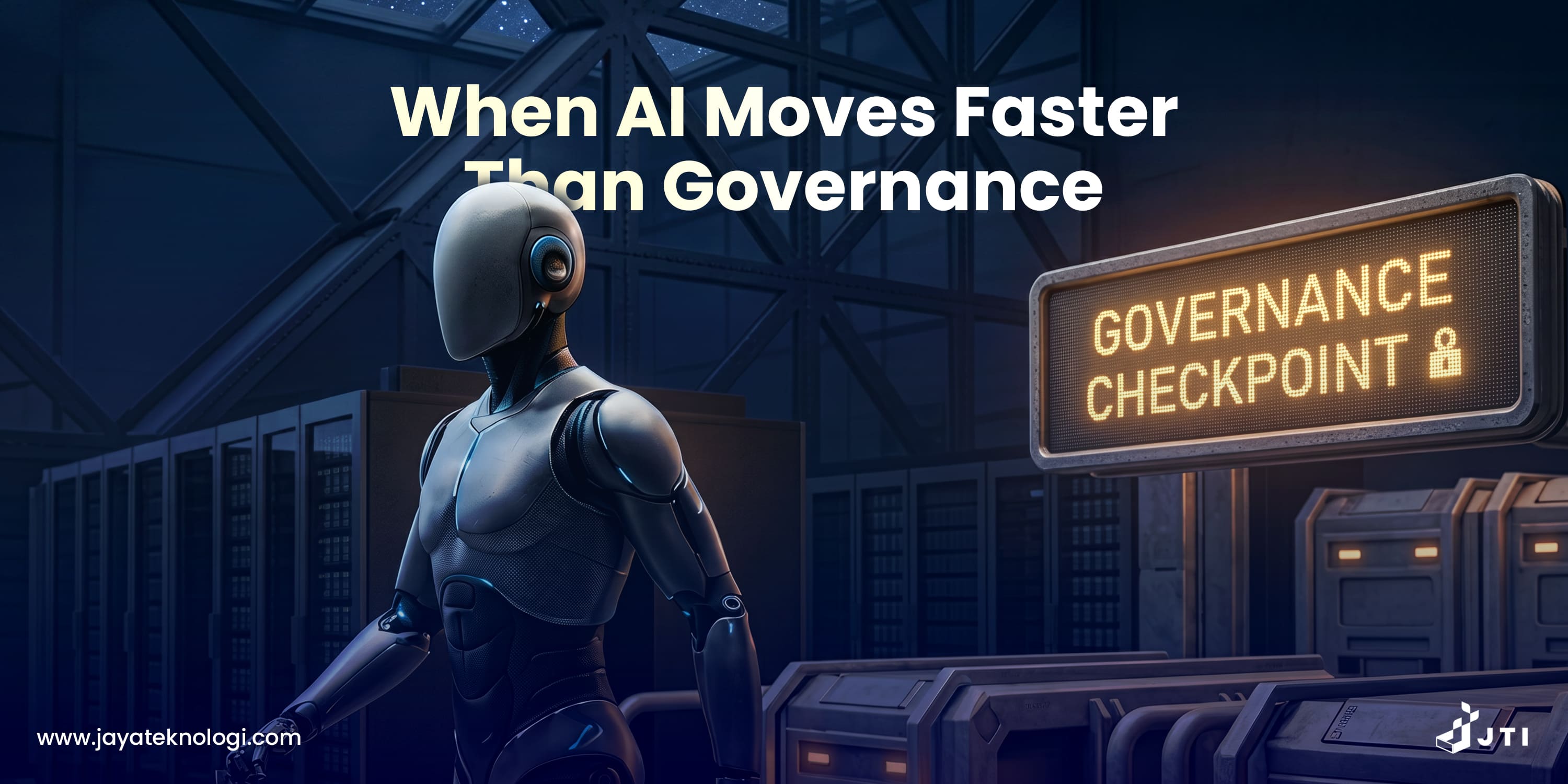
When AI Moves Faster Than Governance
As AI adoption accelerates, Shadow AI is becoming a growing enterprise risk. Learn why governance, visibility, and AI kill switches are essential for responsible AI adoption.
The conversation around AI has shifted once again.
Not long ago, organizations were asking how they could adopt AI. The focus was on identifying use cases, increasing productivity, and finding ways to gain a competitive advantage.
Today, many companies face a different reality. AI adoption is no longer limited to strategic initiatives led by IT or digital transformation teams. Employees across departments can access powerful AI tools in seconds. They can generate reports, analyze data, create content, and automate workflows without waiting for formal approval.
This accessibility has accelerated innovation. It has also introduced a new challenge: governance struggling to keep pace with technology.
The result is a phenomenon known as Shadow AI.
What Is Shadow AI?
Shadow AI refers to the use of artificial intelligence tools, models, or services without the visibility, approval, or governance of the organization.
In most cases, it does not emerge from malicious intent. An employee may upload data into a public AI tool to speed up analysis. A team may subscribe to an AI platform without involving procurement or IT. A department may automate part of its workflow using AI without informing security teams. Each decision may seem harmless on its own.
However, when these activities occur across multiple departments, organizations can quickly lose visibility into where data is going, how decisions are being made, and what systems are influencing critical business processes.
The challenge is not that employees want to use AI.
The challenge is that AI becomes embedded into operations faster than governance can adapt.
Why Visibility Matters More Than Ever
For many years, organizations focused on controlling infrastructure, applications, and data access.
AI introduces a new layer of complexity. Unlike traditional software, AI systems can influence decisions, generate recommendations, and in some cases execute actions automatically. When these systems operate outside approved governance frameworks, the risks extend beyond cybersecurity.
Business leaders may not know which AI models are being used. Compliance teams may not know where sensitive information is being processed. IT teams may not know which workflows depend on external AI services. Over time, this lack of visibility creates operational blind spots.
And blind spots become difficult to manage when AI starts playing a larger role in day-to-day operations.
The Rise of Autonomous AI
The discussion becomes even more important as AI evolves beyond simple chat interfaces.
Modern AI systems are increasingly capable of acting as agents. They can perform multiple tasks, connect with applications, access data sources, and execute workflows with minimal human intervention. This shift creates significant opportunities.
Processes become faster. Decisions become more data-driven. Operational efficiency improves.
At the same time, organizations must prepare for a different question:
What happens when an AI system behaves unexpectedly?
The answer is where the concept of a kill switch becomes relevant.
More Than an Emergency Button
The term "kill switch" often sounds dramatic.
In reality, it represents a simple principle. Organizations should always maintain the ability to stop an AI-driven process when necessary.
A kill switch provides a mechanism to pause, disable, or isolate AI systems when abnormal behavior, security concerns, compliance violations, or operational risks are detected.
Its purpose is not to limit innovation. Its purpose is to ensure that human oversight remains available when automated systems encounter situations they were not designed to handle.
Just as modern infrastructure includes failover mechanisms and disaster recovery plans, AI systems require governance controls that allow organizations to intervene when needed.
Governance Should Enable Innovation
One common misconception is that governance slows progress. In practice, the opposite is often true.
Organizations with clear governance frameworks can adopt new technologies faster because responsibilities, boundaries, and risks are already defined.
Instead of preventing AI adoption, governance creates the confidence required to scale it. This includes understanding where AI is used, what data it can access, how outputs are validated, and when human intervention is required.
The goal is not to control every action. The goal is to maintain enough visibility and accountability to ensure AI remains aligned with business objectives.
When Control Becomes a Competitive Advantage
As AI becomes increasingly integrated into business operations, the companies that succeed will not necessarily be those that deploy the most AI tools. They will be the ones that deploy AI responsibly.
Shadow AI highlights how quickly innovation can spread across an organization. The concept of a kill switch highlights something equally important: the need for control.
The future of AI is not a choice between innovation and governance. The future belongs to organizations that can balance both. Because the most valuable AI systems are not simply the most powerful. They are the ones that remain visible, manageable, and trusted as they scale.