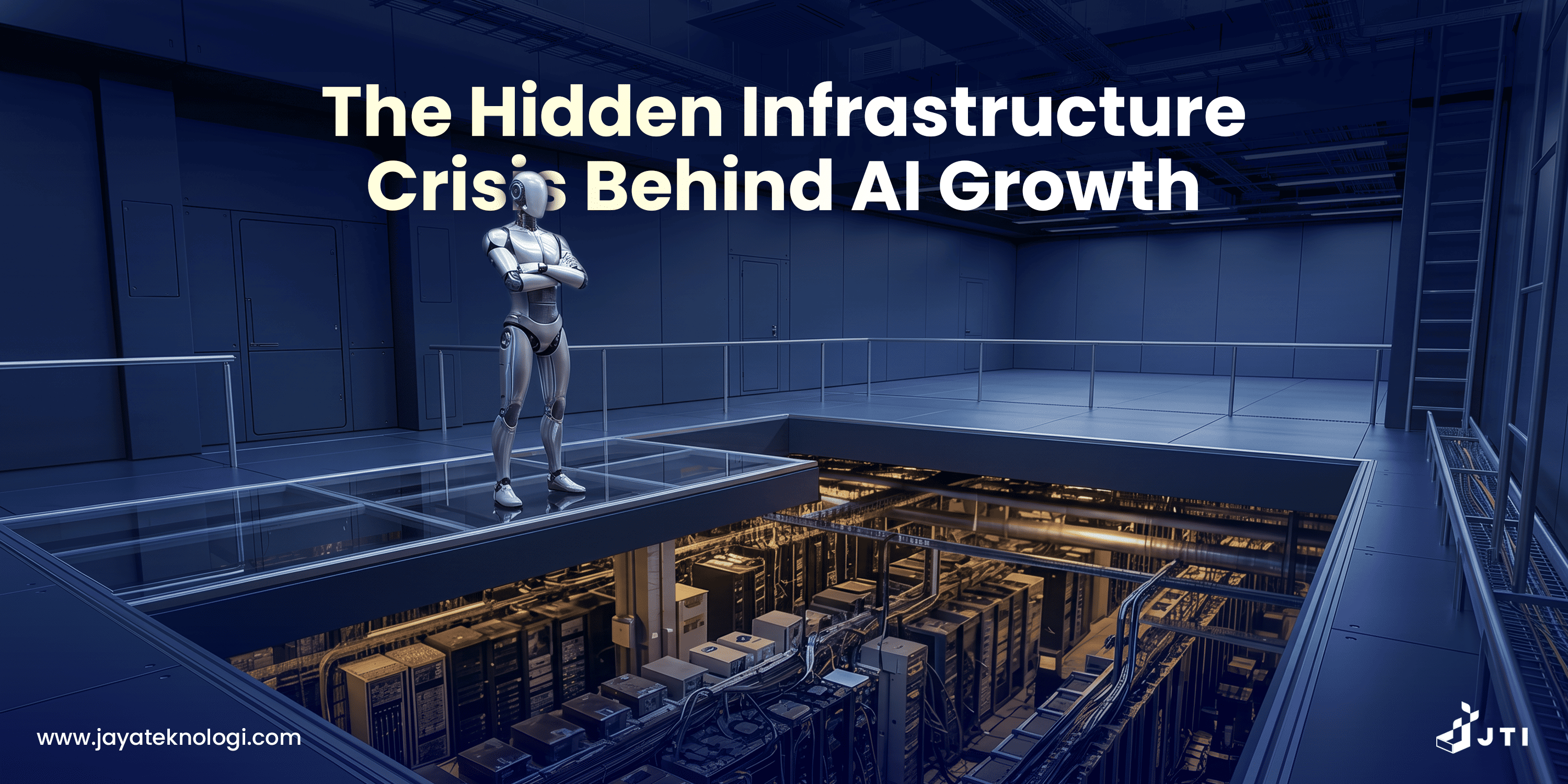
The Hidden Infrastructure Crisis Behind AI Growth
AI is driving unprecedented demand for data centers, electricity, and cooling. Discover why infrastructure may become the biggest challenge behind the future growth of Artificial Intelligence.
Artificial Intelligence is experiencing unprecedented growth.
Every month, new AI models become more capable. Organizations are integrating AI into customer service, software development, cybersecurity, healthcare, manufacturing, and countless other business functions. What was once considered an emerging technology has quickly become a strategic priority for enterprises worldwide.
Much of the conversation focuses on what AI can do. Far less attention is given to what AI needs to operate.
Behind every AI application, every chatbot, and every intelligent recommendation lies an infrastructure that is becoming increasingly difficult to sustain. As organizations continue to expand their AI capabilities, a new challenge is emerging, one that is less visible but equally critical.
The real bottleneck may no longer be AI innovation itself. It may be the infrastructure powering it.
AI Runs on Data Centers, Not Just Algorithms
It is easy to think of AI as software. In reality, every AI model depends on an enormous amount of computing infrastructure.
Training and running modern AI models require high-performance processors, massive storage systems, advanced networking, and sophisticated cooling technologies. All of these components are housed inside data centers that operate continuously to deliver the computing power AI demands.
As AI workloads continue to increase, so does the pressure placed on these facilities. The challenge is no longer limited to adding more servers. It is about ensuring the entire infrastructure can support rapidly growing computational demands.
The Hidden Challenge: Power
Among all infrastructure requirements, electricity has become one of the most significant constraints.
AI workloads consume substantially more power than many traditional enterprise applications. Training large language models, running inference at scale, and supporting GPU-intensive workloads require enormous amounts of electricity, often operating around the clock.
As AI adoption accelerates, data centers are experiencing unprecedented increases in energy demand.
In some regions, utility providers are already facing difficulties supplying enough electricity for new large-scale data center projects. Power availability, once considered a basic infrastructure requirement, is becoming a strategic business concern.
This shift changes how organizations think about digital transformation. Infrastructure planning is no longer only about computing capacity. It is increasingly about energy capacity as well.
Cooling Is Becoming as Important as Computing
Higher power consumption inevitably generates more heat.
Traditional cooling approaches that worked for conventional workloads are reaching their practical limits as AI infrastructure becomes denser and more powerful.
To maintain reliability, many organizations are exploring advanced cooling technologies, including liquid cooling and hybrid cooling systems designed specifically for high-density AI environments.
Cooling is no longer simply an operational expense. It has become an essential factor affecting performance, sustainability, and long-term infrastructure planning.
Without effective thermal management, even the most advanced AI hardware cannot operate efficiently.
Infrastructure Planning Has Become a Strategic Decision
As AI investments continue to grow, infrastructure decisions are becoming business decisions. Organizations must now evaluate whether existing environments can support future AI workloads without compromising performance, availability, or sustainability.
Questions that once belonged exclusively to IT teams are now reaching executive discussions.
Can current facilities handle increasing energy demand?
Should workloads remain on-premises, move to the cloud, or adopt hybrid architectures?
How can organizations balance AI performance with operational costs and sustainability goals?
Answering these questions requires more than purchasing new hardware. It requires a long-term infrastructure strategy.
Efficiency Will Matter More Than Capacity
For years, expanding infrastructure often meant deploying additional servers.
The AI era introduces a different perspective. Simply increasing capacity is no longer enough if energy consumption, operational costs, and environmental impact continue growing at the same pace.
Organizations are increasingly focusing on workload optimization, intelligent resource allocation, energy-efficient hardware, and AI-assisted infrastructure management.
The objective is shifting from building larger data centers to building smarter ones. Efficiency is becoming just as important as performance.
The Future of AI Depends on the Infrastructure Beneath It
Artificial Intelligence continues to redefine how businesses operate. Yet every advancement depends on infrastructure that remains largely invisible to end users. The discussion about AI often centers on algorithms, models, and applications.
However, the long-term success of AI will depend just as much on electricity, cooling, networking, and data center architecture.
The organizations that prepare for this hidden infrastructure challenge today will be better positioned to scale AI tomorrow. Because ultimately, the future of AI is not determined only by how intelligent the models become. It is also determined by whether the infrastructure beneath them can keep up.